Emergencies
What to do before, during, and after each kind of emergency. In a crisis right now, use the short Emergency page instead — this page is for learning and preparing.
- Earthquake
- Home fire
- Wildfire
- War & conflict
- Pandemic
- Flood
- Extreme heat
- Dust storms
- Power & water outages
- Chemical incidents
Earthquake
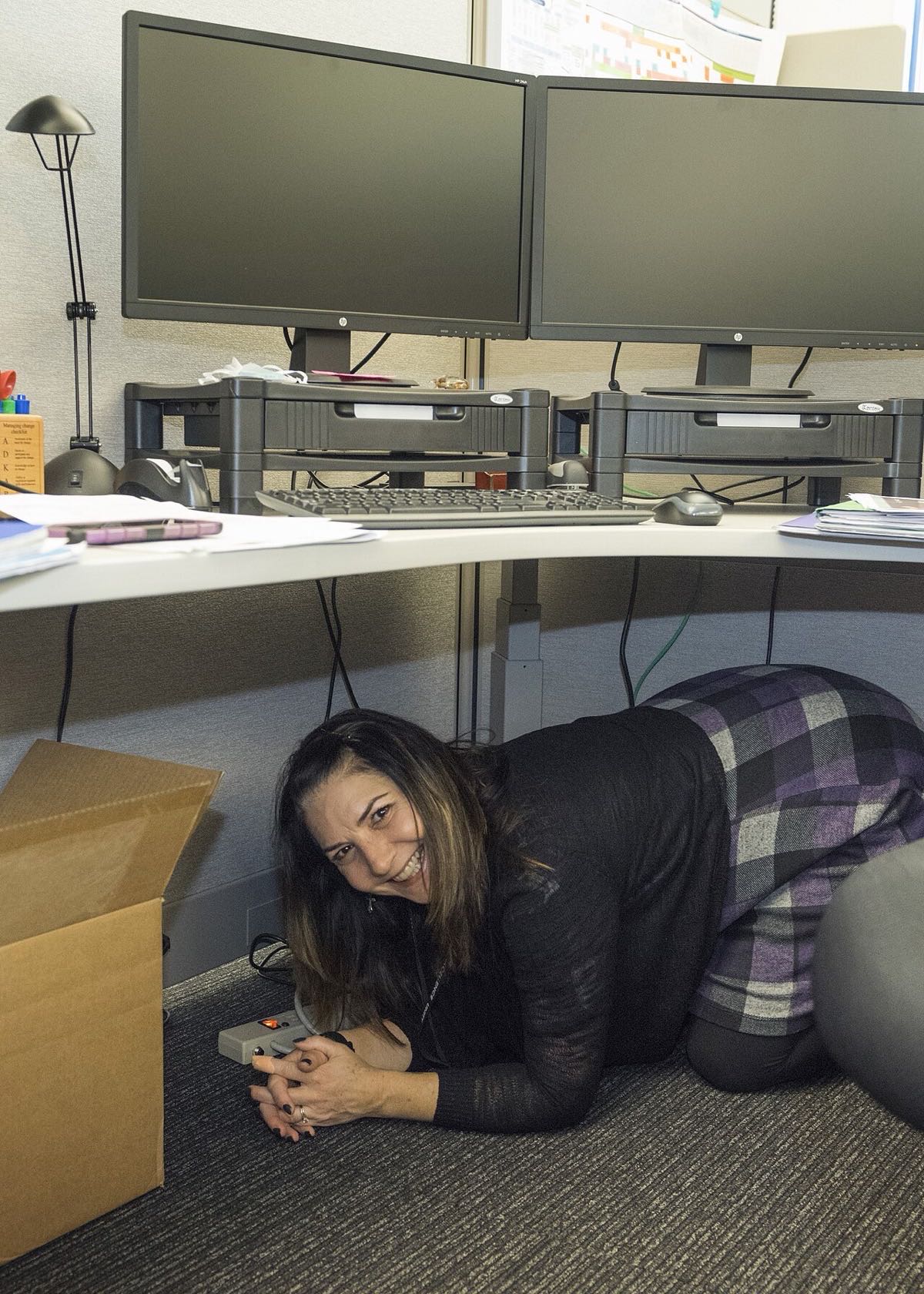
Most earthquake injuries come from falling objects, broken glass, and panicked running — not from buildings collapsing. The single habit that protects you is automatic: Drop, Cover, Hold On, wherever you are, the moment shaking starts.
Before
- Fix the furniture. Strap tall bookcases and wardrobes to the wall. Move heavy objects to low shelves. Nothing heavy above beds — no mirrors, shelves, or framed pictures over pillows.
- Know your spots. In each room, agree where you would drop: under the dining table, beside the interior hallway wall. Practice it with the kids as a game.
- Shoes and torch by the bed. The classic earthquake injury is feet cut by glass in the dark. Keep sturdy shoes and a torch under or beside each bed.
- Know your shut-offs. Learn where and how to turn off gas, water, and electricity — see Shelter & Engineering.
- Secure the water heater and anything on wheels. A toppled water heater can break a gas line and also spills your best emergency water supply.
- Agree the family plan. Meeting point outside the home, and the out-of-area contact — fill in My Plan.
During — shaking
- Drop to hands and knees before the quake throws you down.
- Cover head and neck. Get under a sturdy table if one is within a few steps; otherwise crouch against an interior wall, away from windows, and shield your head with your arms.
- Hold on to the table leg and move with it until shaking fully stops.
- In bed: stay in bed, face down, pillow over your head and neck. Running in the dark over broken glass is worse.
- Outdoors: move to open ground away from buildings, walls, lamp posts, and power lines. Then drop and cover your head.
- Driving: pull over away from bridges, overpasses, buildings, and power lines. Stay in the car with your seatbelt on until shaking stops.
After
- Expect aftershocks — drop and cover again for each one.
- Put on shoes before you take a step. Check yourself, then each family member, for injuries.
- Smell for gas. If you smell it: no switches or flames, open windows, shut the gas valve, leave — see gas leak steps.
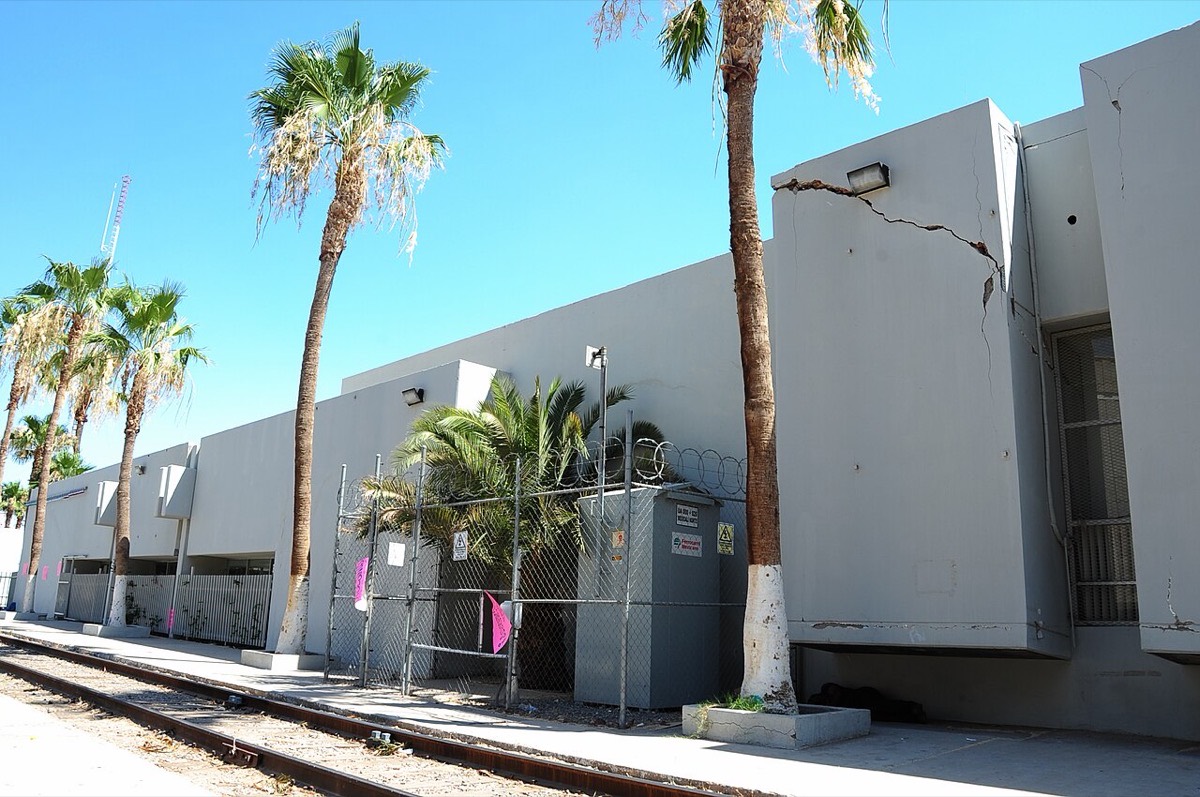
- If the building is visibly damaged (cracks, tilted walls, jammed doors), take the go-bags and get out. Use stairs, never lifts. Go to your meeting point.
- Check on neighbors, especially older people living alone.
- Send one short “we're OK + location” message to your out-of-area contact, then keep phone use minimal — networks are overloaded and your battery is now precious.
- Listen to local radio for damage reports and instructions.
- Do not re-enter damaged buildings for belongings. Aftershocks finish what the main quake started.
Home fire
A room can go from a small flame to unsurvivable in under three minutes. Fire plans are about seconds: early warning, a known way out, and everyone out fast. Most fatal fires happen at night — the smoke detector is what wakes you.
Before
- Smoke detectors in the kitchen area (heat detector is better in the kitchen itself), hallway, and every bedroom corridor. Test monthly. Change batteries yearly.
- Fire extinguisher in the kitchen and one per floor. Learn PASS: Pull the pin, Aim at the base of the flames, Squeeze, Sweep side to side. Only fight a fire smaller than a wastebasket, with your back to the exit.
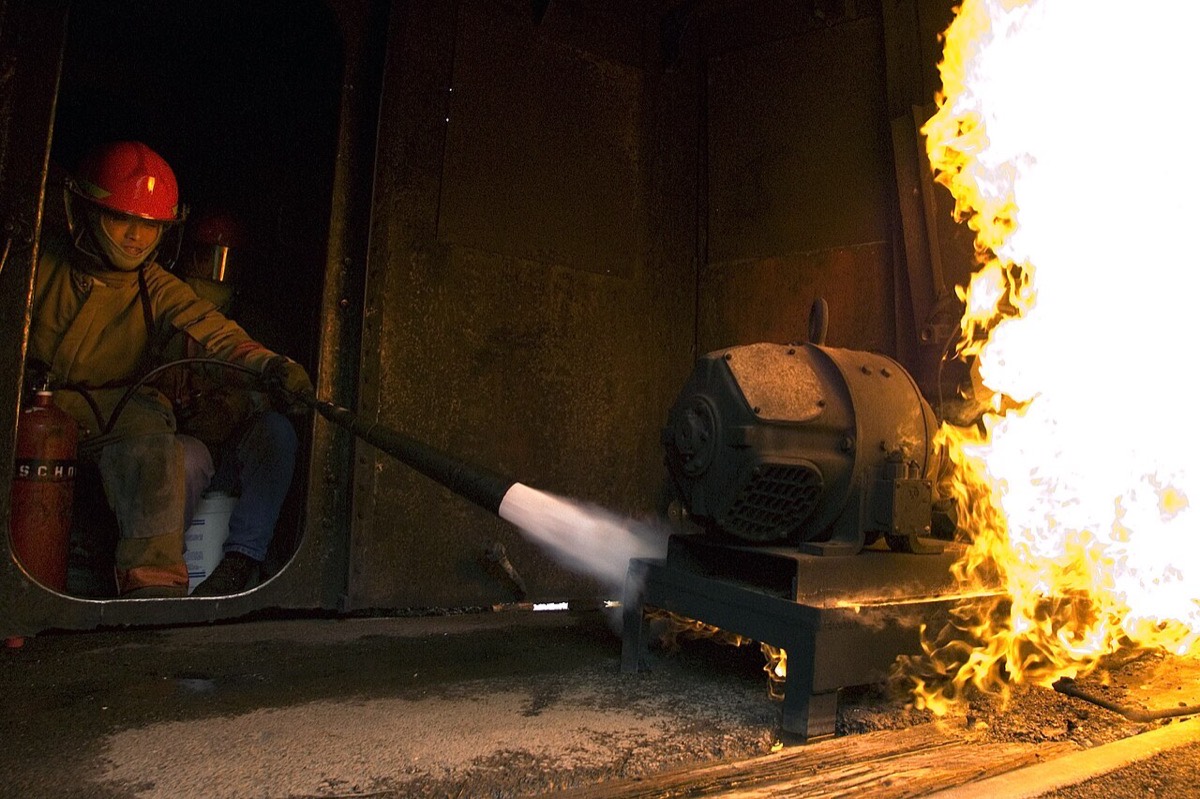
PASS in practice: the stream goes at the base of the flames, not into them, sweeping side to side. Photo: U.S. Navy, public domain. - Fire blanket mounted near (not above) the stove for pan fires.
- Two ways out of every room. Walk them with the family. Agree the outdoor meeting point. Practice a night drill once a year — including crawling.
- Kitchen and charging habits: never leave frying unattended; charge phones and battery packs on hard surfaces, not beds or sofas; no overloaded extension cords; keep heaters a meter from anything that burns.
- Keep keys in door locks that need them at night, so exits open instantly in the dark.
During
- Shout “FIRE!” — wake everyone. Seconds matter more than certainty.
- Get out immediately. Take nothing. Do not dress, do not search for valuables or pets.
- Smoke: crawl on hands and knees — heat and poison gases rise; the breathable air is at the floor.
- Before opening any closed door, touch it with the back of your hand. Hot door or smoke seeping through: leave it shut, use the second way out.
- Close doors behind you as you go — a closed door holds a fire back for many minutes.
- Meet at the meeting point. Count heads. Call the fire service from outside.
- Never go back in — not for people, pets, or papers. Tell firefighters who is missing and where they are likely to be.
Pan fire: turn off the heat if you can reach the knob safely, slide a lid or fire blanket over the pan, leave it covered. Never pour water on burning oil — it explodes into a fireball.
After
- Do not re-enter until the fire service says it is safe — fires re-ignite, and structures weaken invisibly.
- Treat every burn and every smoke inhalation seriously. Anyone with a hoarse voice, sooty nose, or persistent cough after breathing smoke needs medical assessment.
- Photograph damage for insurance before touching anything.
- Throw away food, medicines, and cosmetics exposed to heat or smoke.
Wildfire & brush fire
Dry scrub, palm groves, and rubbish fires spread with the wind faster than people expect, and the smoke harms you long before flames arrive. The winning move is always the same: leave early.
Before
- Clear a defensible space: within 10 m of the house, remove dead vegetation, dry palm fronds, rubbish, and stored fuel — and reduce fuels out to 30 m where terrain allows. Keep gutters and flat roofs free of dry debris.
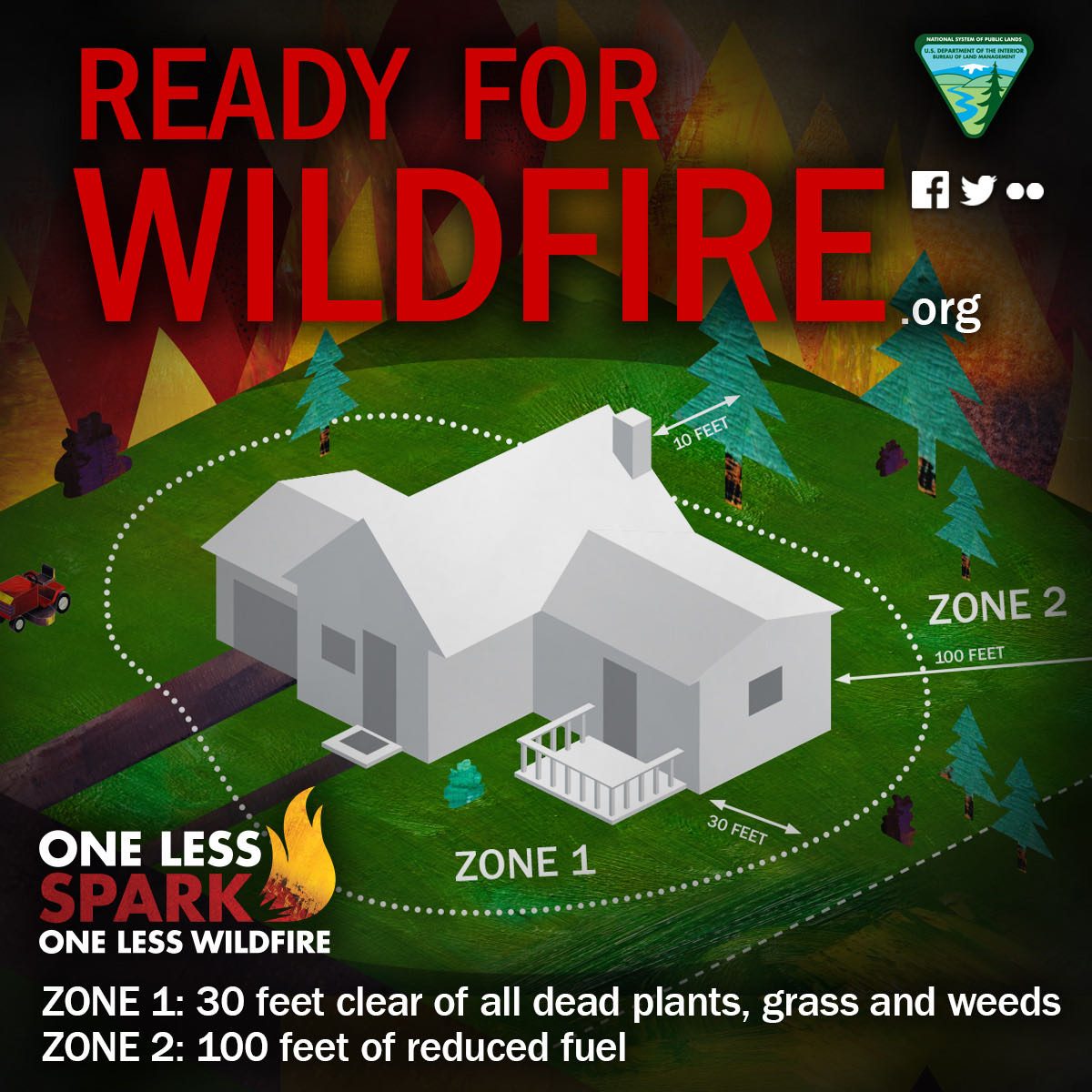
Defensible space zones (US BLM guidance, in feet: 30 ft ≈ 10 m clear zone, 100 ft ≈ 30 m reduced-fuel zone). Image: Bureau of Land Management California, public domain. - Store gas cylinders and fuel away from the house wall, valves closed.
- Keep a hose that reaches around the house, and know your outdoor water taps.
- Prepare an evacuation habit: go-bags ready, car above half a tank, and two different routes out of your area (fire or police may close one).
- Have N95/FFP2 masks for smoke days.
During
- Leave early. If authorities say evacuate, or smoke is thickening and you feel unsure — go. Early departure is safe and calm; late departure through smoke on a jammed road is the classic wildfire death.
- Dress in long sleeves and trousers of cotton or wool (synthetics melt), sturdy shoes, a cap.
- Before leaving, if time genuinely allows: close all windows and doors, shut off gas, move flammable furniture away from windows, leave lights on so firefighters see the house.
- Drive with headlights on, windows up, air on recirculate. Never drive into thick smoke you cannot see through.
- Trapped by fire in a car: park in the clearest area you can find — bare ground, wide road, car park — away from vegetation. Engine off, lights on. Stay inside, below window level, covered with anything to shield from radiant heat. A car protects far better than open air.
- Trapped on foot: find the largest clear area — plowed field, rocks, road. Lie face down in a depression, cover your body, breathe close to the ground until the front passes.
After
- Return only when officials allow. Watch for smoldering spots, weakened trees, and damaged power lines.
- Check the roof and hidden corners for embers for several hours — houses often ignite after the front has passed.
- Keep masks on: ash and smoke linger for days. Keep children from playing in ash.
War & armed conflict
Civilians survive conflict mostly through preparation, distance from fighting, and disciplined information habits. The goals are simple: stay away from targets, protect the family from blast and debris, keep supplies deep enough to avoid dangerous trips, and know when leaving beats staying.
Before — while things are calm
- Deepen supplies quietly: two weeks minimum of water, food, and medicines (see checklists). Refill prescriptions early. Keep cash in small notes — ATMs and card machines fail early.
- Choose your shelter spot now: the most protected space you have — basement, stairwell core, or an interior room on the lowest floor, away from windows and exterior walls. More walls between you and outside = better. See safe rooms.
- Prepare documents: originals in the grab folder, copies stored separately and digitally — see the documents checklist.
- Fuel and vehicles: keep the car above half a tank always. Agree with family which vehicle, which routes (two directions), and where you would go — a named relative or town, not “somewhere safe”.
- Communications: battery radio, power banks, and the family contact plan with an out-of-area contact — see Communication & strategy.
- Learn basic bleeding control (tourniquets and packing) — blast injuries are bleeding injuries.
During — sheltering
- At the first sound of explosions or sirens, move everyone to the shelter spot. Bring the go-bags, water, and radio if they are not already there.
- Explosions very close: lie flat on the floor, mouth slightly open, hands over head and neck. Stay down through the whole volley — pauses often precede more.
- Stay away from windows at all times. Fly glass causes most urban blast injuries. Tape and heavy curtains reduce it; distance beats both.
- Sit against solid interior walls, below window level. Keep shoes on.
- Count the family every time you settle. Assign each adult a child to physically hold if you must move.
- Wait long after silence before moving around. Listen to local radio at set times (e.g., on the hour) to save battery.
During — daily life in a conflict zone
- Plan errands in one trip, at quieter hours, by routes away from military positions, government buildings, and crowds. Two people go, family knows the route and the return time.
- Queues (bread, fuel, aid) are historically dangerous places — collect at off-peak times where possible, and never linger.
- At checkpoints: slow down early, follow instructions exactly, keep hands visible, have documents ready, do not film, do not argue. Keep children calm and belted.
- Unexploded munitions: never touch or approach anything unusual — fallen rockets, small cylinders, wires, toys or attractive objects in odd places. Mark the location from a distance, tell everyone, and report it. Teach children this rule above all others.
- Do not photograph military positions, damage to defense sites, or checkpoints — it can endanger you legally and physically.
- Keep water containers filled at all times; refill after every use. Infrastructure fails suddenly.
Staying informed without drowning
- Battery/crank AM-FM radio is your baseline — it works when mobile networks are cut. Find your reliable local stations now and write the frequencies in My Plan.
- Check news at fixed times (morning, midday, evening), not continuously. Continuous monitoring exhausts you and amplifies rumors.
- Verify anything that demands immediate action before acting on it — see verifying rumors. Panic-driven evacuations onto dangerous roads kill.
Evacuating
- Decide by your pre-agreed triggers, not by panic — see the stay-or-evacuate framework. Leaving is usually best done early or during formal safe-passage windows, not in the middle of active fighting.
- Take: people, documents folder, go-bags, water, medicines, cash, phone + power banks, radio.
- Travel in daylight unless authorities direct otherwise. Use announced routes. Convoy with neighbors if possible.
- Tell your out-of-area contact the plan before you move: route, destination, expected time.
- If separated: everyone knows the rule — go to the agreed rendezvous, or get any message to the out-of-area contact.
After
- Continue treating unfamiliar objects and damaged areas as dangerous — unexploded ordnance persists for years.
- Assume water is contaminated until confirmed otherwise — purify everything (how).
- Expect strong emotional reactions in everyone, especially children, weeks after safety returns. This is normal — see stress and helping children.
Pandemic & serious outbreaks
Pandemics are marathons. The physical protections are simple and boring — distance, ventilation, masks, hand hygiene, vaccination when available. The harder parts are supplies, routines, and morale over months.
Before
- Keep the standing two-week home supply (food, water, medicines, soap) so you can reduce shopping trips at short notice.
- Stock: N95/FFP2 masks, soap, hand sanitizer (60%+ alcohol), a working thermometer, paracetamol and ibuprofen, oral rehydration salts, and gloves.
- Keep routine vaccinations current for the whole family.
- Know your local health system: which clinic, which hospital, what telehealth options exist. Write them in My Plan.
During
- Follow official public-health instructions — they are tuned to the actual disease, which this page cannot predict.
- Reduce contacts: fewer trips, fewer visitors, distance in queues. Outdoors is much safer than indoors; ventilated indoors is much safer than sealed rooms.
- Wear a well-fitting mask (N95/FFP2 best) in crowded indoor spaces during respiratory outbreaks.
- Wash hands with soap for 20 seconds after being out, before eating, after coughing/sneezing.
- Do not touch your face with unwashed hands.
- Get vaccinated when a vaccine is offered through official channels.
If someone at home falls ill
- Give them their own room if possible, and their own dishes, towels, and bathroom (or disinfect the shared bathroom after each use).
- One person nurses them, always the same person, masked; the vulnerable (elderly, pregnant, chronically ill) keep maximum distance.
- Air the sick room several times a day.
- Care for the illness at home per caring for the sick and Remedies: fluids, rest, fever control, watching for danger signs.
- Danger signs that mean “get medical help now”: difficulty breathing, blue/gray lips, chest pain, confusion, cannot keep fluids down, infant refusing feeds — full list under when to evacuate someone.
After / between waves
- Restock everything used, immediately — waves repeat.
- Debrief as a family: what ran out, what routines worked, what the kids needed.
- Watch for lingering anxiety and low mood; recovery of spirits lags recovery of health. See stress management.
Flood & flash flood
In dry climates, rain kills mostly through flash floods: a distant storm sends a wall of water down wadis, underpasses, and low roads that were bone-dry minutes before. Cars are where most people die. The rules are absolute: go up, never into moving water, never drive through it.
Before
- Know your ground: is your home, street, or usual route low-lying? Where are the underpasses and wadi crossings you drive daily? Plan rain-day alternatives.
- Clear roof drains and yard drains before the rainy season.
- Store valuables and documents above floor level; keep the documents folder waterproof.
- During storm warnings: charge everything, park the car on high ground, and postpone travel.
During
- Move to higher ground or an upper floor at the first sign of rising water. Do not wait for instructions to save your life.
- Never walk through moving water. 15 cm of moving water knocks an adult off their feet; the depth is unknowable and the ground beneath may be gone.
- Never drive into flooded roads. 30 cm of moving water floats and carries a car. “Turn around — don't drown.”
- If the car stalls in rising water: abandon it immediately and move to high ground. Cars are metal traps in floods.
- If swept into water: point your feet downstream, on your back, and work toward the edge; grab anything stable.
- Stay out of wadis, storm drains, and underpasses during and for hours after rain — the flood arrives from rain you never saw.
- Avoid contact with floodwater — it carries sewage, chemicals, and sometimes live electricity from downed cables.
After
- Do not enter a flooded building until electricity is confirmed off at the main breaker.
- Wear gloves and boots for cleanup. Wash hands after every contact with flood residue. Disinfect surfaces that floodwater touched (see disinfection).
- Discard any food, drink, or medicine touched by floodwater. When in doubt, throw it out.
- Treat all tap and well water as contaminated until authorities declare it safe — purify everything (how).
- Dry the house fast (ventilation, fans) to beat mold; strip soaked carpets and gypsum board.
Extreme heat
Heat is the quiet killer of our climate — it takes the elderly, outdoor workers, small children, and the chronically ill, usually indoors, usually over several bad days, and especially when nights stay hot or the power fails. Treat a heat wave with power outage as a full emergency.
Before
- Prepare the coolest room: lowest floor, north-facing or most shaded, minimal glass. Blackout curtains or external shutters/foil on sun-facing windows.
- Stock extra water (well beyond the normal ration), oral rehydration salts, spray bottles, and battery-powered fans.
- Service the AC before summer; know which rooms your backup power (if any) can actually cool.
- Identify a cooled public fallback: mall, mosque, community center — where you would take the family if home cooling fails for days.
- List the people you will check on: elderly relatives and neighbors, anyone living alone.
During a heat wave
- Drink water steadily all day — do not wait for thirst. Pale yellow urine is the target. Add rehydration salts if sweating heavily.
- Shift all effort to early morning; nothing strenuous between late morning and sunset.
- Keep sun out of the house: curtains and shutters closed on the sunny side all day. Open everything at night if the air outside cools below the air inside.
- Live in the coolest room. Wear loose, light clothing. Cool the body directly: wet cloths on neck and forearms, cool showers, feet in water — this works even without AC.
- Use fans while air temperature is below body temperature; when it is hotter than ~40°C, fans alone can add heat — combine them with wet skin, and prefer the coolest room.
- Never leave anyone — child, elder, or animal — in a parked car, not for one minute.
- Check on your list of vulnerable people daily, in person if possible.
- Know the two heat illnesses: heavy sweating, cramps, nausea, weakness = heat exhaustion → cool and rehydrate now. Confusion, staggering, fainting, hot skin = heatstroke → emergency, cool aggressively and call for help. Full guide: heat illness.
If the power fails in a heat wave
- Treat it as an emergency for the vulnerable from hour one — decide early whether to relocate them to a place with power.
- Move everyone to the coolest room; close the house against the sun; hang wet sheets in doorways where any breeze passes.
- Cool bodies, not air: wet skin plus any fan or hand fan, cool water immersion for feet and forearms.
- Slow everything down. Cancel all exertion. Sleep on the lowest floor.
- Watch each other for confusion or stopped sweating — that is heatstroke; act per emergency steps.
After
- Keep drinking; dehydration lingers a day behind the heat.
- Restock water, salts, batteries. Note what failed (curtains, fans, plans) and fix it before the next wave.
Dust & sand storms
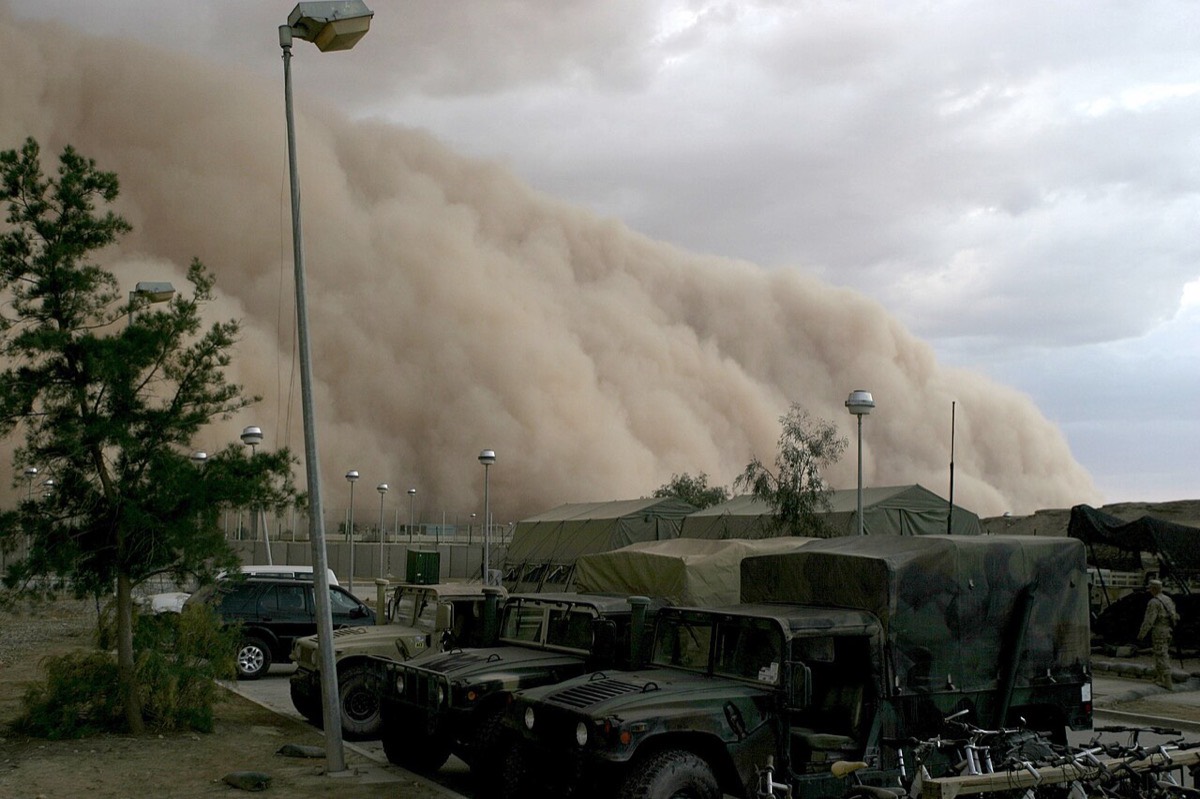
A dust storm's dangers are breathing and driving. The dust wall arrives fast, drops visibility to meters, and fills the air with fine particles that punish lungs for days — especially children, the elderly, and anyone with asthma or heart disease.
Before
- Keep N95/FFP2 masks at home and in the car — cloth over the mouth is a poor substitute but better than nothing.
- Weather-strip leaky windows and doors; know which room seals best (usually the bathroom or an interior room).
- Asthma/COPD in the family: keep reliever inhalers stocked, in date, and in known places; have the action plan agreed with the doctor.
- During storm season, check forecasts before long drives; postpone travel on warning days.
During
- Get indoors before the wall arrives. Shut all windows and doors; block gaps with damp towels.
- Turn off AC units that draw outside air (window units, fresh-air settings). Recirculate-only is fine.
- Keep vulnerable people in the best-sealed room. Masks on if dust is entering.
- Caught outside: mask or damp cloth over nose and mouth, protect eyes (goggles, glasses, cloth), back to the wind, get behind or inside anything solid. Do not shelter beside trees or unsecured structures in high wind.
- Driving: never drive into the dust wall. Exit the road completely — well clear of the traffic lane — stop, handbrake on, and turn all lights off, foot off the brake pedal. Drivers in dust follow tail lights; lit lights invite a rear-end collision. Wait until visibility returns.
- If you must keep moving (no safe pull-off): slow right down, lights on low beam, horn periodically, use the painted line as a guide — and pull off at the first opportunity.
After
- Air the house only after the air visibly clears. Wipe surfaces with damp cloths (dry sweeping re-suspends dust).
- Anyone with tight chest, wheeze, or persistent cough — treat per their action plan; seek care if breathing is labored.
- Rinse dusty eyes with clean water. Wash food-prep surfaces before cooking.
- Check AC filters and clean or replace them — a clogged filter cripples cooling in the heat.
Power & water outages
Outages are the most likely emergency of all, and the multiplier inside every other one. A prepared home rides out days of no power or water as an inconvenience, not a crisis. The dangerous mistakes are generators indoors, candles, opened fridges, and unpurified water.
Before
- Light: LED torches and lanterns in known places in every main room, plus batteries. Prefer battery light over candles — candles burn homes down during outages.
- Power: charged power banks (check them monthly), car charger, and ideally a solar panel charger. Know that your car is a generator for phones.
- Water: stored drinking water (see how much), and containers to fill when warning comes. Know your building's situation — many homes lose water pressure when pumps lose power.
- Food: the two-week pantry, a camping stove with fuel, and a manual can opener.
- A battery/crank radio for information when mobile networks fail with the power.
- Medicines needing refrigeration (e.g., insulin): know the manufacturer's room-temperature allowance, and prepare a cool box plan.
- If anyone depends on powered medical equipment, arrange backup power and register with your utility now, not during the outage.
During — power outage
- Keep fridge and freezer doors closed. An unopened fridge keeps food safe about 4 hours; a full freezer about 48 hours (24 if half-full).
- Unplug sensitive electronics (AC units, computers, TV) to protect them from the surge when power returns. Leave one light switched on so you notice restoration.
- Switch phones to low-power mode; texts over calls; one information check per hour, not constant scrolling.
- In heat, follow the heat-wave-without-power steps — this combination is the killer.
- Never run a generator, charcoal grill, or camping stove indoors, in a garage, or by a window/vent. Carbon monoxide is invisible, odorless, and kills whole families at night. Generators: outdoors, 6+ meters from openings.
- Check the fridge rules before eating: see food safety without refrigeration. When in doubt, throw it out.
Skill card: blackout-proofing the fridge → Skill card: jump-starting a car →
During — water outage
- At the first sign or warning, fill the bathtub, buckets, pots, and bottles while pressure lasts. Tub water is for flushing and washing, not drinking.
- Start rationing immediately: drinking first (3–4 L per person per day in heat), cooking second, hygiene third. Flushing is last — use greywater, and flush only when necessary.
- Your hidden reserves: the water heater tank (30–80 L, drain from the bottom valve after turning off its power/gas) and the toilet cistern (not bowl; skip if it uses cleaning tablets). Purify before drinking: how.
- Switch to hygiene-without-running-water routines: Hygiene & sanitation. Hand hygiene must not slip — that is how outage becomes outbreak.
- When supply returns, it may come back dirty: run taps until clear, and treat the first day's water as suspect — purify drinking water until quality is confirmed.
After
- Restock everything used — batteries, water, fuel — the same week.
- Check and discard risky food per the rules.
- Note the pain points and fix one: the outage you just had is the rehearsal for the longer one.
Chemical incidents
Industrial accidents, warehouse fires, road tanker crashes, or attacks can release toxic gases and smoke. You usually cannot identify the chemical — and you don't need to. The universal defenses: distance, staying upwind/uphill, sealed shelter, and removing contaminated clothing.
Before
- Know what is near you: industrial areas, fuel depots, major truck routes. Note which direction they lie from home.
- Prepare a sealed-room kit: plastic sheeting pre-cut for the chosen room's window and vents, wide tape, towels, scissors — stored in that room. Best room: interior, few openings, on an upper floor (many toxic gases are heavier than air), ideally with access to water.
- Keep the battery radio there — official instructions decide shelter vs. evacuate.
During
- Strange smell, hissing cloud, many people suddenly coughing/collapsing, or official alert: act immediately.
- If the release is nearby outdoors: move away crosswind — wind on your side, not carrying the plume to you — and uphill. Distance is the best protection.
- Then shelter: get inside the nearest solid building. Close every window and door.
- Turn off AC, fans, and anything that moves air in from outside. Close vents.
- Go to your sealed room. Tape plastic over the window and vents, wet towels under the door. A sealed room dramatically slows gas entry for the hours a plume takes to pass.
- If exposed: remove outer clothing carefully — cut it off rather than pulling it over the head — bag it, and wash skin and hair with generous water and soap. Rinse stinging eyes with clean water for 10–15 minutes.
- Breathe through a wet cloth if the air irritates.
- Radio on: officials will say whether to stay sealed or evacuate, and when the plume has passed. Follow the instruction even if it feels counterintuitive — moving during the plume is usually the worst option.
After
- Air the house thoroughly only after the all-clear.
- Anyone with breathing difficulty, chest pain, burns, or persistent eye/skin irritation needs medical evaluation — some agents injure with delay.
- Do not eat exposed food; wash surfaces, dishes, and toys before use. Discard porous exposed items.
- Bagged contaminated clothing stays sealed outside until authorities advise on disposal.